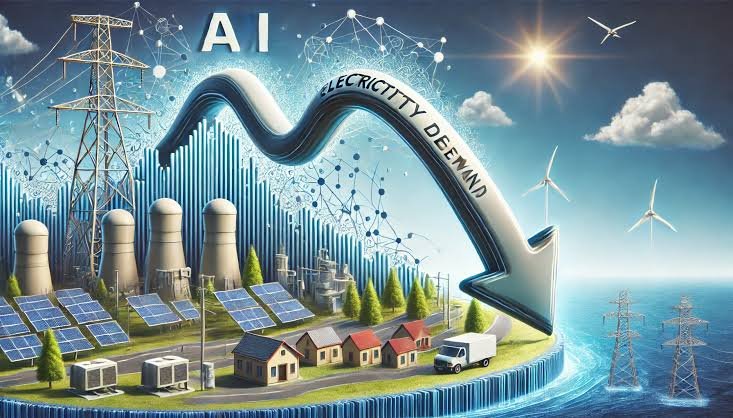
Artificial intelligence is transforming far more than software, search engines, and business operations. Behind every AI model, chat bot, image generator, video tool, automated system, and advanced computing application is a physical infrastructure that requires enormous amounts of electricity. As AI adoption accelerates, data centers are becoming one of the fastest-growing sources of electricity demand in major economies.
The rapid expansion of AI data centers is creating a new relationship between technology and energy. For decades, investors primarily associated the technology sector with semiconductors, software, cloud computing, and telecommunications. Today, electricity generation, power grids, transformers, cooling systems, batteries, natural gas infrastructure, nuclear power, and renewable energy are increasingly important parts of the AI economy.
The International Energy Agency (EA) estimates that global electricity consumption from data centers was around 485 terawatt-hours (Two) in 2025. Under its central outlook, that figure could roughly double to around 950 Two by 2030, representing about 3% of global electricity demand. AI-focused data centers are expected to grow even faster than data centers overall.
This development has major implications for technology companies, energy producers, utilities, governments, investors, and consumers. It could increase demand for electricity generation while also creating opportunities across infrastructure, renewable energy, natural gas, nuclear power, grid equipment, cooling technologies, and energy storage.
At the same time, the AI data-center boom creates difficult questions. Who will pay for new power plants and transmission lines? Can electricity grids expand quickly enough? Will data centers increase electricity prices for households? How much additional renewable energy will be needed? What role will natural gas and nuclear power play? And could energy shortages eventually limit the growth of artificial intelligence?
This article explains the connection between AI data centers and electricity demand, why power consumption is increasing, how the energy market may respond, and what the trend could mean for the global economy and investors.
What Are AI Data Centers?
A data center is a specialized facility containing computing equipment, networking systems, storage infrastructure, cooling systems, backup power equipment, and other technology required to operate digital services.
Traditional data centers already consume substantial amounts of electricity. However, AI data centers are different because artificial intelligence workloads often require highly powerful processors operating at significant computational intensity.
AI models are trained using large numbers of specialized chips. Once trained, those models must also run inference workloads whenever users interact with them. AI systems can therefore require electricity during both the development and deployment stages.
Modern AI infrastructure commonly relies on graphics processing units (GPU), application-specific accelerators, high-speed networking equipment, advanced storage systems, and sophisticated cooling technology.
The combination of computing power and cooling requirements means that AI facilities can have much higher power densities than conventional data centers.
The EA notes that traditional data centers may operate at around 10 to 25 megawatts (MW), while hyper scale AI facilities can exceed 100 MW. The largest facilities under construction can reach dramatically higher levels.
This is important because electricity demand is not simply increasing because there are more data centers. The amount of electricity required by each new generation of AI infrastructure can also be substantially higher.
Why Is AI Increasing Electricity Demand?
The growth in electricity demand from AI comes from several interconnected factors.
1. Larger AI Models
AI models have become increasingly sophisticated. More advanced models generally require greater computational resources during training and, depending on architecture and usage, during inference.
Training a large model can involve thousands of high-performance processors operating simultaneously for extended periods.
The electricity consumed by a single AI request may be small compared with household electricity use, but billions of requests can create significant aggregate demand.
2. Rapid Growth in AI Users
AI has moved from a specialized technology used mainly by researchers and technology companies to a mainstream digital service.
Consumers use AI for writing, search, education, coding, translation, image creation, video generation, and productivity.
Businesses are adopting AI for customer service, software development, analytics, marketing, security, financial analysis, logistics, and automation.
As the number of AI users grows, the total amount of computing performed by data centers also increases.
3. More Energy-Intensive AI Applications
Not all AI workloads consume the same amount of electricity.
Simple text generation may require considerably less energy than advanced reasoning, image generation, video generation, or complex agent workloads.
The EA notes that emerging AI applications such as video generation, reasoning, and agent tasks can consume substantially more energy than simple text-based queries.
This creates an important uncertainty for future electricity demand. Improvements in AI efficiency could reduce energy consumption per task, but rapidly increasing usage could offset those efficiency gains.
4. Continuous Operation
Data centers generally operate around the clock.
AI services cannot simply turn off every night because users and businesses expect cloud-based applications to remain available.
This makes data centers different from some industrial facilities whose electricity consumption can be shifted more easily.
Their continuous demand can place pressure on power systems, particularly in regions where large clusters of data centers are built.
How Much Electricity Do Data Centers Use?
Data centers currently represent a relatively small percentage of global electricity consumption, but their growth rate is significant.
According to the EA, global data-center electricity consumption reached approximately 485 Two in 2025. The EA expects consumption to reach roughly 950 Two by 2030 under its central projection.
That means data-center electricity consumption could almost double in approximately five years.
The EA also reports that data-center electricity consumption increased by about 17% in 2025, while electricity consumption from AI-focused data centers increased even faster, by around 50%.
These figures help explain why AI has become an important topic in the global energy market.
The growth is particularly significant because data centers are geographically concentrated. A large data center may not have a huge impact on global electricity demand by itself, but several facilities in the same region can place considerable pressure on local electricity infrastructure.
The United States and the AI Electricity Boom
The United States is one of the most important markets for AI data-center development.
The country hosts major cloud providers, AI companies, semiconductor companies, and hyper scale data-center operators. As these companies expand AI infrastructure, electricity demand is increasing.
The EA projects that U.S. electricity demand will grow by nearly 2% annually through 2030, with data centers responsible for around half of the total increase.
The U.S. Department of Energy has also highlighted data-center deployment as a significant contributor to near-term electricity demand growth. It cites an PER estimate that data centers could consume as much as 9% of U.S. electricity generation annually by 2030, compared with approximately 4% of total load in 2023.
This represents a major shift after years of relatively modest electricity-demand growth in the United States.
For investors, the trend is important because increasing electricity consumption can create opportunities and challenges across the entire energy value chain.
AI Data Centers and the Power Grid
One of the biggest challenges facing the AI industry is not necessarily generating electricity. It is delivering electricity to the right location at the right time.
A data center may require hundreds of megawatts of power, but electricity grids were not always designed around sudden concentrations of extremely large consumers.
Building a new data center may take a few years. Building transmission lines, substations, transformers, and generation capacity can take longer.
This creates a potential infrastructure mismatch.
Technology companies may be ready to deploy new AI facilities faster than utilities can provide the required grid connections.
The EA has identified grid constraints, equipment bottlenecks, and long infrastructure lead times as important factors affecting the expansion of data-center electricity supply.
Transmission Infrastructure
Transmission lines transport electricity over long distances.
If a data center is built in an area with limited local generation, additional transmission capacity may be required.
However, new transmission projects can face regulatory, environmental, land-use, and financing challenges.
Substations
Large data centers may require major substations to transform and distribute electricity.
Substation equipment can become a critical bottleneck when many facilities are constructed simultaneously.
Transformers
Transformers are essential components of electricity infrastructure.
Rapid growth in demand for grid equipment can increase pressure on manufacturers and supply chains.
The EA has specifically warned that increasing AI power density will test supply chains for technologies such as power electronics and transformers.
Why Power Density Matters
Power density refers to the amount of electricity consumed within a specific physical area.
AI servers can have extremely high power densities because powerful processors generate substantial amounts of heat.
The EA reports that AI server power density increased dramatically between 2020 and 2025 and could rise further by 2027.
Higher power density creates two simultaneous challenges:
- More electricity must be delivered to the facility.
- More heat must be removed from the facility.
This means AI data-center growth is also increasing demand for advanced cooling technologies.
AI Data Centers and Cooling
Computing equipment generates heat.
Traditional data centers often use air-based cooling systems, but increasingly powerful AI processors can require more sophisticated solutions.
Liquid cooling is becoming increasingly important for high-density AI infrastructure.
Liquid cooling can transfer heat more efficiently than conventional air cooling in certain high-performance computing environments.
The growth of liquid cooling could therefore create opportunities for companies involved in thermal management, cooling equipment, pumps, heat exchanges, and related infrastructure.
Cooling also affects electricity consumption.
A data center does not use all its electricity directly for computing. Additional electricity is required for cooling, networking, storage, lighting, power conversion, and other infrastructure.
Improving cooling efficiency can therefore reduce the total electricity required per unit of computing.
Renewable Energy and AI Data Centers
Renewable energy is expected to play a major role in meeting the electricity needs of data centers.
Solar and wind power have become increasingly competitive in many markets, and technology companies have already used long-term contracts and other procurement strategies to support renewable electricity development.
The Ear’s analysis indicates that renewals could provide a large share of the additional electricity required by data centers, supported by storage and broader grid development.
However, renewable energy has an important challenge: intermittency.
Solar generation changes throughout the day, while wind generation varies according to weather conditions.
AI data centers, by contrast, typically need highly reliable electricity around the clock.
This means renewable generation may need to be combined with:
- Battery storage
- Transmission infrastructure
- Hydroelectric power
- Natural gas generation
- Nuclear power
- Grid-scale energy management
- Demand-response systems
The future AI energy system is therefore unlikely to depend on a single electricity source.
Solar Power and Data Centers
Solar power can be attractive for data centers because solar generation can be deployed relatively quickly compared with some large conventional power projects.
Technology companies can purchase renewable energy through power purchase agreements (Papas), helping finance new renewable projects.
However, solar power production is strongest during daylight hours, while data centers operate continuously.
Battery storage and grid connections can help address this mismatch.
The combination of solar generation, batteries, and grid power could become increasingly important as AI electricity demand rises.
Wind Power and AI Infrastructure
Wind power is another major source of renewable electricity.
Large wind projects can produce significant amounts of electricity, but their output varies with weather conditions.
Transmission is particularly important because strong wind resources are often located far from major population centers and data-center clusters.
Building transmission infrastructure can therefore determine whether new renewable electricity can effectively serve AI data centers.
Natural Gas and AI Data Centers
Natural gas is likely to remain an important part of the electricity mix in several markets.
Natural gas power plants can provide dispatch able electricity, meaning they can generate electricity when needed rather than depending entirely on weather conditions.
The EA expects natural gas to contribute significantly to meeting data-center electricity demand, particularly in the United States.
This creates an interesting connection between the technology and energy sectors.
AI growth can increase demand for:
- Natural gas
- Gas turbines
- Pipelines
- Electricity generation
- Grid infrastructure
- Backup generation
However, natural gas also raises questions about greenhouse-gas emissions and long-term energy policy.
The balance between reliability, affordability, emissions, and speed of deployment will be an important issue for policymakers and energy companies.
Nuclear Energy and the AI Boom
Nuclear power is receiving renewed attention because it can provide large quantities of reliable, low-carbon electricity.
Unlike solar and wind, nuclear plants can generate electricity continuously.
This characteristic makes nuclear power potentially attractive for large electricity consumers such as AI data centers.
Technology companies and energy developers have shown growing interest in nuclear power and advanced nuclear technologies.
The EA expects nuclear generation to contribute to meeting growing data-center electricity demand, particularly in countries such as the United States, China, and Japan.
Small modular reactors, often called Sirs, are another technology receiving attention.
These reactors are designed to be smaller and potentially more modular than traditional nuclear plants.
However, nuclear projects can face significant challenges involving regulation, financing, construction timelines, safety requirements, and public acceptance.
The Economics of AI Electricity Demand
The AI data-center boom is not only an energy story. It is also an economic story.
Large technology companies are investing billions of dollars in computing infrastructure.
The EA reported that capital expenditure by five major technology companies exceeded $400 billion in 2025 and was expected to rise further in 2026.
This spending creates economic activity across multiple industries.
Companies building AI infrastructure need:
- Semiconductors
- Servers
- Networking equipment
- Construction services
- Electricity
- Cooling equipment
- Real estate
- Steel
- Copper
- Transformers
- Power generation
- Batteries
- Fiber-optic networks
The economic multiplier can therefore extend well beyond the technology sector.
Which Industries Could Benefit?
The growth of AI electricity demand could create opportunities across several industries.
Utilities
Electric utilities may experience increased demand from data centers.
Higher electricity consumption can support revenue growth, although utilities must also invest heavily in generation and grid infrastructure.
Energy Producers
Natural gas, renewable energy, nuclear, and other electricity-generation companies may benefit from additional demand.
Electrical Equipment
Companies producing transformers, switch gear, cables, substations, power electronics, and related equipment may see increased demand.
Construction
Building large data centers requires construction workers, engineers, contractors, electricians, cooling specialists, and infrastructure suppliers.
Semiconductor Companies
AI data centers require advanced processors.
As computing demand increases, semiconductor manufacturers and equipment suppliers remain strategically important to the AI infrastructure ecosystem.
Cooling Technology
Advanced processors require advanced thermal management.
Cooling technology could become an increasingly important part of data-center capital spending.
Could AI Increase Electricity Prices?
One of the most important questions for consumers is whether growing data-center demand will increase electricity bills.
The answer depends heavily on local market structure, generation capacity, grid investment, regulation, and how the costs of infrastructure expansion are allocated.
If electricity demand grows faster than supply, wholesale electricity prices can rise.
If utilities build sufficient generation and transmission capacity ahead of demand, price pressure may be more manageable.
Another issue is cost allocation.
Large data centers may require expensive grid upgrades. Policymakers and regulators must determine how much of those costs should be paid by the data-center operator and how much should be spread across other electricity customers.
This issue is already becoming part of policy debates in the United States. In September 2026, the U.S. House advanced legislation addressing the potential economic impact of large electricity consumers such as data centers, including consideration of infrastructure costs.
Data Centers and Local Communities

Although data centers may represent a relatively small percentage of global electricity consumption, their local impact can be significant.
A large facility can consume hundreds of megawatts in a particular area.
This can affect:
- Electricity infrastructure
- Water resources
- Land use
- Local taxes
- Employment
- Electricity prices
- Environmental conditions
Some communities welcome data centers because they can generate tax revenue, construction activity, and economic development.
Others have raised concerns about electricity use, water consumption, environmental impacts, and infrastructure costs.
Recent reporting from Silicon Valley illustrates this tension, with local residents and environmental groups challenging proposed AI data-center expansion while officials emphasize potential economic benefits.
Water Consumption and AI Data Centers
Electricity is not the only resource required by large data centers.
Cooling systems can also require significant amounts of water depending on the technology used and the local climate.
Water usage can become particularly controversial in regions experiencing drought or water stress.
This has encouraged data-center developers to investigate:
- Closed-loop cooling
- Liquid cooling
- Recycled water
- Air cooling
- More efficient cooling designs
- Waste-heat recovery
Future data-center development may therefore depend not only on electricity availability but also on local water conditions.
AI and the Future of Global Energy Markets
The relationship between AI and electricity could become one of the defining economic trends of the next decade.
For much of the digital era, software growth was often perceived as relatively disconnected from physical resource consumption.
AI challenges that assumption.
The more powerful AI becomes, the more important physical infrastructure becomes.
AI requires:
- Chips
- Electricity
- Cooling
- Buildings
- Fiber
- Water
- Energy storage
- Power generation
- Transmission
This means the future of AI will depend partly on the future of energy infrastructure.
The Global Electricity Demand Outlook
The EA expects global electricity demand to grow strongly through 2030.
Its Electricity 2026 outlook projects average annual global electricity-demand growth of approximately 3.6% between 2026 and 2030. The organization identifies data centers, industry, electric vehicles, air conditioning, and other forms of electrification as important contributors.
The EA also expects electricity demand to grow faster than total energy demand.
This is significant because economies are becoming increasingly dependent on electricity.
AI is one part of a much larger electrification trend.
Electric vehicles require electricity.
Heat pumps require electricity.
Industrial processes are becoming more electrified.
Data centers require electricity.
Manufacturing facilities increasingly depend on advanced electrical equipment.
The result is a broader transformation of the global energy system.
AI Data Centers and Electricity Investment
Growing demand creates a need for investment.
Utilities may need to construct new generation facilities.
Transmission operators may need to expand networks.
Data-center operators may need dedicated substations.
Governments may need to accelerate permitting.
Energy companies may need to develop new renewable, gas, nuclear, and storage projects.
Financial institutions may play an important role in funding this infrastructure.
This creates opportunities for investors, but it also introduces risks.
Large infrastructure projects require substantial capital and can face delays, cost overruns, regulatory uncertainty, and changes in technology.
The Investment Opportunity Around AI Energy
Investors interested in the AI boom often focus on major technology companies.
However, the AI infrastructure opportunity extends beyond software and semiconductors.
The electricity demand created by AI could support multiple infrastructure categories.
Potential areas include:
- Electric utilities
- Power-generation companies
- Renewable energy developers
- Natural gas producers
- Nuclear technology
- Electrical equipment
- Transformers
- Data-center construction
- Cooling systems
- Batteries
- Grid-management technology
- Semiconductor manufacturing
This does not mean every company in these industries will benefit equally.
Investors need to evaluate company-specific factors such as debt, valuation, capital expenditures, contracts, regulatory exposure, competitive advantages, and expected cash flow.
Risks for AI Infrastructure Investors
The AI electricity theme has substantial opportunities, but it also carries risks.
AI Investment Could Slow
If companies reduce AI capital expenditure, fewer data centers may be built.
Technology Efficiency Could Improve
More efficient processors and software could reduce electricity consumption per AI task.
That could slow electricity-demand growth even while AI usage increases.
Grid Bottlenecks
A shortage of transmission capacity or transformers could delay projects.
Regulatory Changes
Governments may impose new environmental, energy, or infrastructure requirements.
Electricity Prices
Higher electricity prices could increase operating expenses for data-center operators.
Interest Rates
Data centers and energy infrastructure require large amounts of capital.
Higher financing costs can reduce the profitability of new projects.
Overbuilding
If too many data centers are constructed relative to actual AI demand, some infrastructure investments could generate lower returns than expected.
AI Efficiency Could Change the Energy Equation
It is easy to assume that AI will always require exponentially more electricity.
The reality is more complicated.
AI hardware and software efficiency is improving.
New chips can perform more calculations per unit of energy.
Software optimization can reduce unnecessary computation.
Model architectures can become more efficient.
Inference systems can route simple tasks to smaller models while reserving large models for complex tasks.
These improvements could reduce the electricity required per AI task.
However, efficiency improvements do not automatically mean total electricity consumption will decline.
If the cost of AI falls, people and businesses may use substantially more AI.
This is an example of a rebound effect: greater efficiency can make a technology cheaper and encourage greater consumption.
The EA therefore emphasizes uncertainty surrounding future AI electricity demand because efficiency improvements and rapidly expanding usage can move in opposite directions.
The Importance of Energy Storage
Battery storage could become increasingly important for AI infrastructure.
Storage can help balance variable renewable generation and electricity demand.
For example, solar power generated during the afternoon can be stored and used later.
Grid-scale batteries can also provide fast-response services that help stabilize electricity systems.
As data-center demand increases, batteries could become part of a broader strategy for maintaining grid reliability.
However, battery deployment itself requires investment in manufacturing capacity, minerals, transmission connections, and recycling.
The Role of Demand Response
Not every computing workload must necessarily occur at the same time.
Some AI workloads may be flexible enough to move between locations or times based on electricity availability.
For example, certain training jobs could potentially be scheduled when renewable electricity production is high.
This could allow data-center operators to reduce grid stress without interrupting critical services.
The development of flexible computing workloads could therefore become an important part of future AI energy management.
The European AI Energy Challenge
Europe is also preparing for substantial data-center expansion.
Recent European policy discussions have increasingly focused on energy efficiency, water use, transparency, and the impact of data centers on electricity systems.
Recent reporting indicates that the European Union is considering requirements for large data centers to disclose energy and water efficiency information. Data centers currently account for approximately 2.5% of EU electricity consumption, with capacity expected to expand substantially as AI development accelerates.
Europe faces a particularly complicated challenge because electricity prices, energy security, climate policy, and industrial competitiveness are closely connected.
The region wants to support AI development while managing energy costs and emissions.
Asia and AI Electricity Demand
Asia is likely to be another major center of AI infrastructure growth.
China, Japan, South Korea, Singapore, Malaysia, and other Asian economies are developing data-center infrastructure.
The EA expects electricity demand in China to continue growing rapidly and sees rising demand across India and Southeast Asia as well.
Data centers are only one contributor to Asian electricity demand.
Industrial growth, air conditioning, electric vehicles, manufacturing, and urbanization are also increasing electricity consumption.
This means AI data centers will compete for electricity within already rapidly growing energy markets.
Could Electricity Become the Limiting Factor for AI?
One of the most interesting questions is whether electricity availability could eventually limit AI growth.
The AI industry can purchase more chips, construct more buildings, and deploy more software, but all those systems ultimately require electricity.
If grid infrastructure cannot expand quickly enough, data-center projects may face delays.
The EA has highlighted bottlenecks across the energy and technology supply chain that could constrain the pace of data-center expansion.
This means electricity infrastructure could become a strategic competitive advantage.
Countries with abundant, affordable, reliable electricity may be better positioned to attract AI data-center investment.
Electricity as a Competitive Advantage
For decades, technology companies often prioritized access to skilled workers, research universities, venture capital, and customers.
AI adds another factor: electricity.
A region with reliable electricity and fast grid connections can become an attractive location for data centers.
Regions with insufficient grid capacity may struggle to compete even if they have excellent technology ecosystems.
This could change the geography of the AI industry.
What This Means for Businesses
Businesses outside the technology industry should also pay attention to rising electricity demand.
Higher power prices can affect operating costs for:
- Manufacturers
- Retailers
- Warehouses
- Hotels
- Hospitals
- Offices
- Transportation companies
At the same time, businesses that provide energy infrastructure to data centers could experience increased demand.
The AI electricity boom therefore has implications for the wider economy.
What Consumers Should Watch
Consumers do not need to become energy-market experts to understand the trend.
Several indicators can reveal whether AI data-center growth is putting pressure on electricity systems.
Important indicators include:
- Wholesale electricity prices
- Utility rate increases
- Grid connection delays
- New power-plant announcements
- Natural gas prices
- Renewable-energy investment
- Transformer shortages
- Transmission construction
- Data-center construction permits
- Utility capital-expenditure plans
Tracking these indicators can provide a better picture of the relationship between AI and energy markets.
The Future of AI Data Centers
The next generation of data centers will likely be very different from facilities built a decade ago.
Future designs may incorporate:
- Higher-density AI processors
- Liquid cooling
- On-site power generation
- Battery storage
- Renewable energy
- Advanced energy management
- Nuclear power
- Waste-heat recovery
- More efficient computing hardware
- Flexible workloads
Data centers may increasingly become integrated energy assets rather than simply buildings filled with computers.
Waste Heat and Data Centers
One potentially interesting development is the reuse of waste heat.
Computing equipment generates heat that normally needs to be removed.
Instead of simply releasing that heat into the environment, some data centers may be able to use it for:
- District heating
- Industrial processes
- Greenhouses
- Water heating
The economic feasibility depends heavily on local conditions.
Waste heat is most useful when a nearby customer needs heat.
The Importance of Energy Efficiency
Energy efficiency will remain one of the most important tools for managing AI electricity demand.
Efficiency can be improved at multiple levels.
Chip Efficiency
Processors can perform more calculations using less electricity.
Server Efficiency
Data-center operators can optimize server utilization.
Cooling Efficiency
Advanced cooling systems can reduce electricity required for thermal management.
Software Efficiency
AI developers can optimize models to reduce unnecessary computation.
Grid Efficiency
Utilities can use advanced systems to reduce transmission losses and manage peak demand.
Efficiency does not eliminate the need for new electricity generation, but it can reduce the amount required for each unit of AI output.
AI Could Also Help the Energy Sector
The relationship between AI and electricity is not entirely one-directional.
AI can also help improve energy systems.
Utilities can use machine learning for:
- Electricity-demand forecasting
- Predictive maintenance
- Renewable-energy forecasting
- Grid optimization
- Fault detection
- Battery management
- Energy trading
- Weather forecasting
AI may therefore increase electricity demand while simultaneously helping the energy industry operate more efficiently.
This creates a feedback loop between the technology and energy sectors.
AI, Electricity and Inflation
Rising electricity demand can also have macroeconomic consequences.
If power generation and grid infrastructure fail to expand quickly enough, electricity prices could rise.
Higher electricity prices can increase production costs for businesses.
Those higher costs can contribute to inflationary pressure.
The impact would depend on local energy markets and broader economic conditions.
At the same time, massive infrastructure investment can increase economic activity, employment, manufacturing, and productivity.
AI therefore has the potential to create both inflationary and productivity effects.
The ultimate economic outcome will depend on how quickly supply responds to demand.
AI and the Stock Market
The electricity-demand trend is increasingly relevant to stock-market investors.
AI-related stocks may receive significant attention, but the infrastructure supporting AI can also influence other sectors.
Investors may watch:
- Utility stocks
- Energy stocks
- Semiconductor stocks
- Data-center Reins
- Electrical equipment companies
- Renewable-energy companies
- Natural gas companies
- Nuclear-energy companies
- Battery companies
- Construction companies
However, investors should avoid assuming that an industry benefiting from a macro trend automatically makes every company in that industry a good investment.
Valuation remains important.
A company can operate in a growing industry while still producing disappointing investment returns if expectations are already too high.
AI Data Centers and Real Estate
Data-center real estate is another growing area.
Developers look for locations with:
- Large power availability
- Fiber connectivity
- Suitable land
- Water resources
- Low disaster risk
- Favorable regulations
- Proximity to major markets
Power availability can increasingly become more important than traditional real-estate considerations.
A property without sufficient electricity capacity may have limited value for large AI facilities.
The New Economics of Location
The AI era could change how companies choose data-center locations.
Historically, proximity to users was an important consideration.
Cloud computing and high-speed networks make it possible to locate some computing capacity farther from users.
As electricity demand grows, companies may increasingly prioritize regions with abundant and affordable power.
This could benefit areas with strong renewable resources, existing nuclear capacity, natural gas infrastructure, or excess generation.
What Happens After 2030?
The outlook beyond 2030 is highly uncertain.
AI models could become dramatically more efficient.
Or AI applications could become much more energy-intensive.
Data-center electricity consumption could grow faster than current projections.
Alternatively, economic conditions or infrastructure bottlenecks could slow construction.
The Ear’s analysis recognizes substantial uncertainty in longer-term data-center electricity demand.
The key variables include:
- AI adoption
- Model efficiency
- Hardware innovation
- Electricity prices
- Infrastructure investment
- Interest rates
- Regulation
- Semiconductor supply
- Grid expansion
- Renewable deployment
- Nuclear development
No single forecast can perfectly predict the outcome.
Frequently Asked Questions
How much electricity do AI data centers use?
AI data centers consume substantial amounts of electricity because they operate high-performance computing equipment and sophisticated cooling systems. Global data-center electricity consumption was around 485 Two in 2025, according to the EA, and is projected to approach 950 Two by 2030 under its central outlook.
Why does artificial intelligence require so much electricity?
AI requires electricity for training and running models. High-performance processors operate continuously during intensive workloads, while cooling and supporting infrastructure require additional power.
Will AI increase electricity prices?
AI-driven electricity demand could contribute to higher prices in areas where supply and grid capacity are constrained. The actual effect depends on local electricity markets, new generation capacity, grid investment, and how infrastructure costs are allocated.
What energy sources will power AI data centers?
A combination of renewable energy, natural gas, nuclear power, hydroelectricity, batteries, and grid electricity is likely to supply AI data centers. The exact mix will vary by country and region.
Is nuclear power important for AI?
Nuclear power could become increasingly important because it can provide reliable electricity with relatively low operational carbon emissions. The EA expects nuclear generation to contribute to growing data-center electricity demand in several major markets.
Will renewable energy be enough for AI?
Renewable are expected to provide a significant portion of new electricity supply for data centers, but continuous AI workloads also require reliable power. Storage, transmission, dispatch able generation, and grid management can complement renewable energy.
Could AI electricity demand slow down?
Yes. Improvements in chip efficiency, software optimization, AI model efficiency, economic conditions, financing costs, or grid bottlenecks could slow electricity-demand growth. On the other hand, greater AI adoption and more energy-intensive applications could accelerate demand.
Why are transformers important for AI data centers?
Transformers are essential for connecting electricity generation and high-voltage transmission systems to the lower-voltage networks used by data centers. Rapid data-center construction can therefore increase demand for transformer equipment.
What industries benefit from AI electricity demand?
Potentially affected industries include utilities, energy producers, renewable developers, natural gas companies, nuclear technology companies, electrical-equipment manufacturers, construction companies, cooling-system providers, semiconductor manufacturers, and data-center operators.
Is AI an energy investment theme?
AI can be viewed as an energy and infrastructure theme as well as a technology theme. The expansion of AI requires electricity generation, transmission, cooling, data-center construction, networking, and other physical infrastructure.
Final Thoughts
AI data centers are becoming one of the most important new drivers of electricity demand.
The technology industry is entering a period in which computing power and energy infrastructure are increasingly interconnected. AI models require advanced processors, and those processors require reliable electricity. The electricity must then be delivered through a grid capable of supporting increasingly large and concentrated loads.
The EA expects global data-center electricity consumption to roughly double from around 485 Two in 2025 to approximately 950 Two by 2030. AI-focused data centers are expected to grow even faster than data-center demand overall.
This creates a broad economic opportunity.
Utilities may need to build new generation.
Grid operators may need to expand transmission.
Manufacturers may need to produce more transformers and electrical equipment.
Energy companies may increase investment in natural gas, renewable power, nuclear energy, and storage.
Technology companies will continue developing more efficient processors and data-center systems.
Investors will increasingly have to understand both sides of the AI equation: the digital infrastructure and the physical energy infrastructure supporting it.
The biggest question is not simply whether AI will consume more electricity. It almost certainly will as adoption expands. The more important question is how quickly the global energy system can expand to meet that demand while maintaining affordability, reliability, and environmental objectives.
The answer will influence the future growth of artificial intelligence, the economics of electricity markets, infrastructure investment, and potentially the performance of companies across the technology and energy sectors.
In the coming years, the AI race may therefore become an electricity race as well.
The companies and countries capable of combining advanced computing with reliable, affordable, and salable electricity infrastructure could play an increasingly important role in the next stage of the global digital economy.
Fore more information about this vertical Click Here
For more information Click Here